
Reviewed · WALKING TOURS
Guatemala city Walking Tour and public bus
Guatemala City can feel big and complicated, but this small-group walking route keeps you anchored in the historic center, with a public bus ride included so you move like locals without guessing transit. You get a tight dose of Zone 1 in about 2 to 2.5 hours, hopping between major civic buildings, major churches, and the city’s central market area.
What I like most is how it mixes “look closely” architecture stops with real-life city movement, plus the guides. In the best cases, guides like Armando and Fidencio bring the city to life with clear English and practical context. The main drawback to consider is that the pace can feel a bit slower in the first stretch if you’re hoping to race through photos and move on.
Key highlights to know before you go
- Public bus fare included, so you can ride and orient without paying extra for transport
- Max 15 people, which makes it easier to ask questions and hear the guide
- Lots of Zone 1 coverage in under a half-day, from civic offices to the Cathedral area
- Central Plaza ending point, convenient for continuing on foot or heading back to your hotel
- Heat-smart advice, including bringing sunscreen, water, and a hat for the daytime route
Price and logistics, with real value math
At $30 per person for roughly 2 to 2.5 hours, this is a solid value when you think about what’s included. The biggest “value lever” is that public transportation is part of the price. Transit in Guatemala City can be cheap, but it still adds up, and more importantly, it saves you from figuring out which bus gets you where during your sightseeing time.
You’re also buying a guide’s time, and the stop selection matters. This isn’t just a line of postcards. You move between the civic core, major Catholic landmarks, national communications history, and the market and food zone. That mix is hard to replicate on your own in a short window, especially when you want to understand what you’re seeing, not just photograph it.
What’s not included is also important. Admission tickets are not included (for the stops where a ticket would apply), and there’s no lunch included. If you’re the type who wants to pay for interiors, you should expect to add some small extras.
A short list of other Guatemala City options
- Guatemala City: Walking Tour
★ 4.9 · 42 reviews - Guatemala city walking tour only weekends. 2 persons and up
★ 4.5 · 11 reviews - Graffiti Walking Tour in 4 Grados Norte Guatemala City
★ 5.0 · 9 reviews
Starting at Westin Camino Real, ending at Central Plaza
The tour starts at the Westin Camino Real on Avenida La Reforma (Zone 10), and it ends at Plaza de la Constitución in Zone 1. That matters because it frames your day. You begin with an easy, recognizable meeting point near main roads, and you finish in the heart of the historic center where it’s natural to keep walking.
The end point is also practical: Plaza de la Constitución is one of the best “hub” locations in the city. From there, you can wander, find a snack, or head back using nearby transit. The guide may also help point you toward getting to Transmetro for the hotel area, which is a nice extra when you don’t want to be stuck guessing routes.
And yes, timing matters. The start time is 10:30 am, which is a decent compromise. Later in the day the heat can take the fun out of walking, so this start gives you a fighting chance to see the sites while you still have energy.
Riding the public bus like a local (and why it’s worth it)
Many walking tours look great on paper, but they still fail at one key thing: how you get between neighborhoods and stops. This one solves that with the public bus fare included, turning what could be a logistics headache into part of the experience.
When you ride the bus with a guide, you learn more than the route. You get a sense of the city’s “how it works” rhythm. It also helps with orientation in Guatemala City, where big streets and historic zoning can feel confusing if you’re alone.
If you’re someone who likes to do it properly, this approach is a win. You’re not just standing in one place waiting for a bus. You’re moving at local speed, then stepping off near historic sights that you can actually connect to what you’re learning.
Stop 1: Estación Centro Cívico and the civic power zone
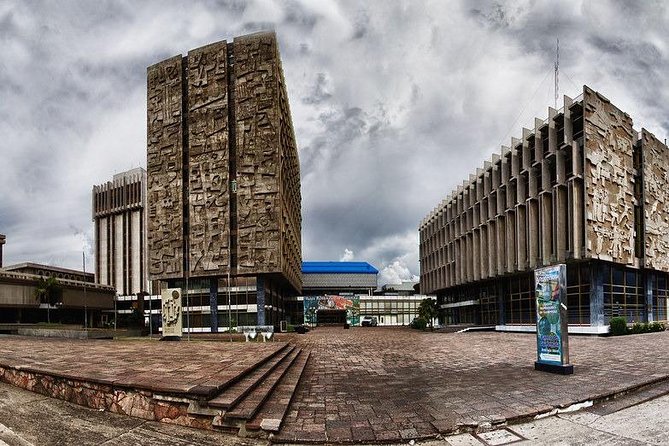
You kick things off at Estación Centro Cívico, a strong start because it sets the theme of the day: Guatemala City’s civic center. Here, you’ll look around at major institutional buildings, including City Hall, Banco de Guatemala, Banco Credito Hipotecario Nacional, and Social Security offices.
Even if you only have a short time, this stop gives you a sense of how the city organized its public life. The buildings help you understand that Zone 1 isn’t just churches and colonial streets. It’s also the machinery of government and finance.
Practical note: this stop is about 15 minutes, and admission tickets are not included. Expect mostly street-level viewing and explanation rather than a museum-style experience.
Nearby, and a completely different day:
- Private Shuttle in Guatemala
★ 5.0 · 262 reviews - Guatemala City Tour
★ 5.0 · 256 reviews - PRIVATE SHUTTLE AIRPORT/ANTIGUA – LAKE ATITLAN or VICEVERSA
★ 5.0 · 220 reviews - Private Ground Transfer Airport – Antigua Guatemala
★ 5.0 · 216 reviews
Stop 2: Diario de Centro América and the National Typography building
Next comes Dirección General del Diario de Centro América y Tipografía Nacional, a stop that can surprise you if you usually think of history as only “old buildings.” This site links to the national printing and publishing world.
You’ll hear how the first national typography building operated roughly from 1894 to 1918, and how in 1935 the president Jorge Ubico pushed a new construction for the National Typography. This is the kind of detail that turns “a building” into a story about how information and state institutions worked.
Time here is about 20 minutes, and again, admission tickets are not included. If you’re hoping for inside access, don’t count on it. This stop shines when you enjoy listening and noticing facades and street context.
Stops 3 and 4: El Calvario (Nuestra Señora de los Remedios) and San Francisco
Then the route shifts into Catholic landmarks with stops that matter because they’re tied to major changes in the city.
At Parroquia Rectoral Nuestra Señora de los Remedios, also known as El Calvario, you’ll learn an especially interesting timeline. The parish was originally on Cerro del Cielito, and in 1936 it was converted into the National Museum of History. Later, it was demolished to extend a major road. That kind of story makes you look at the street differently, like you’re seeing the city’s decisions layered over time.
Time is about 10 minutes, no admission tickets included.
A few minutes later is Iglesia San Francisco, tied to the same broader parish territory connected to the Franciscan friars. It’s a short stop, about 10 minutes, but it adds another piece to the church-heavy feel of Zone 1.
If you’re not into religious architecture, you’ll still likely enjoy these stops because of the urban history angle. The churches are not only religious sites. They’re markers of how the city has grown, rebuilt, and sometimes replaced what was there before.
Stop 5: Palacio de Comunicaciones and the Post and Telegraph story
Next up is the General Directorate of Posts and Telegraphs of Guatemala, formerly Palacio de Comunicaciones. This is one of those stops that feels oddly modern, because it’s about communications infrastructure and national coordination.
You’ll hear that it was designed by Rafael Pérez de León and Enrique Riera, built during Jorge Ubico’s government. Construction began in 1938, and a first phase was inaugurated a couple of years later as part of the president’s birthday celebration. Additional phases finished over the next five years.
Time here is around 15 minutes, and admission tickets are not included.
The value here is the framing. You’re seeing how state power used communication systems to connect the country. It’s history you can understand without needing a textbook.
Stop 6: Casa Ibargüen, from palace-era roots to today’s capital center
Then you move to Casa Ibargüen, located in Zone 1. This is a “stop and picture” moment, because the building once functioned as the Beltranena palace, built in 1778. Today it’s the headquarters of the Foundation of the Historic Capital Center.
You get about 30 minutes here, which is a meaningful chunk compared to some of the other quick hits. That extra time helps because you’re likely to want to look closely and absorb the setting.
Again, admission tickets are not included, so treat this as an appreciation stop. If the space is closed or access is limited, you won’t be losing a “must do” interior visit.
Plaza de la Constitución (Central Park): the kilometer zero of Guatemala
Now you reach Plaza de la Constitución, also called Central Park. This is the natural heart of the day, and it’s not just pretty. It’s functional and symbolic.
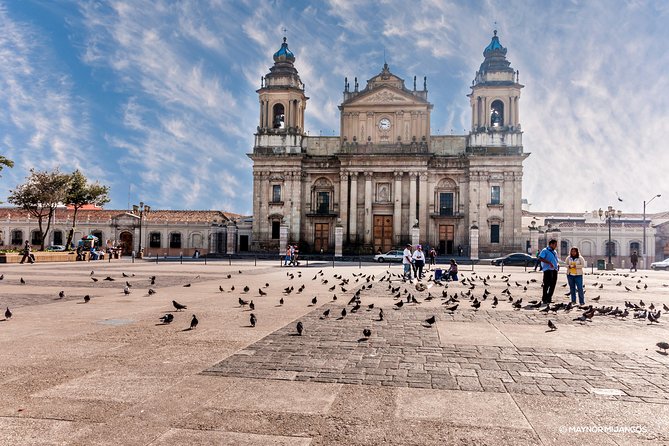
You’ll see how it’s surrounded by major landmarks: the National Palace to the north, the Metropolitan Cathedral to the east, Portal of Commerce to the south, and the Centennial Park and National Library to the west. You’ll also hear that major events happen here, including Independence Day celebrations, concerts, speeches, and student demonstrations connected to the Huelga de todos los Dolores.
The “why you should care” detail is this: the main entrance of the National Palace is kilometer zero of all roads in the Republic of Guatemala. Even if you never plan to think about road kilometers, it anchors the idea that this square is a reference point for the whole country.
Time is about 15 minutes, no admission tickets included.
Stop 8: The Metropolitan Cathedral and the 200-plus-year timeline
With Plaza as your stage, the next major stop is Catedral Metropolitana de Santiago de Guatemala. The big theme here is continuity and change over about 200 years.
You’ll learn it’s survived major events like earthquakes, independence, and a revolution. You’ll also hear about the placement of the Carrara marble altar on July 23, 1860. That date gives the cathedral a grounded, specific milestone instead of vague “it’s old” energy.
Time is about 15 minutes, and admission tickets are not included.
If you’re hoping for a long interior visit, plan for the pace of a short guided stop. This one is about context and exterior impressions, plus a few details that make the cathedral’s presence feel intentional.
Stop 9: Mercado Central, and how the market replaced a messy square
Next is Mercado Central, which is arguably the most practical stop of the day because it connects architecture and planning to everyday life.
You’ll hear a layered origin story. Before independence, there was an abandoned area east of the Cathedral, including the old Plazuela de El Sagrario and a semi-destroyed temple that served as a chapel. There was also a cemetery, and it was later closed due to excess burials. Then Dr. Mariano Gálvez proposed converting the unhealthy square into a proper market for public needs. The plan required moving the cemetery to San Juan de Dios, but work paused because of opposition from church authorities and fears tied to premature exhumation being linked to a cholera concern.
This is history that matters because you can almost feel how public health, power, and economics shaped the market you’ll walk into.
Time is about 20 minutes, no admission tickets included.
Stop 10: San Martín Centro Histórico, plus time for a Guatemala coffee cup
You finish with San Martín Centro Histórico. The stop includes a built-environment story too: the old Pavón House on Paseo de la Sexta and 10 street was revitalized, and it now houses a bakery and a restaurant.
There’s also time to wrap up with a Guatemala coffee cup. The important detail: the tour does not include coffee. So if you want it, you’ll pay for it there, but having a final, comfortable place to stop makes it easier to end without scrambling for your own café.
Time is about 30 minutes, no admission tickets included.
Pace, heat, and how to enjoy the first half
One review comment calls out that the tour can feel slow, especially early on. That lines up with how this route is built: the first half stacks the civic and institutional stops, which naturally take longer to explain.
If you’re a fast walker who wants quick photo stops, you might find yourself wishing it moved faster. My practical advice is to set expectations. This tour works best when you enjoy the “wait, tell me more” part of city walking.
Also bring basics for the climate. One tip that showed up clearly is to pack a hat, sunscreen, and water, because it can get hot. If you’re sweating and distracted, even a great guide loses some of the magic. Dress for heat, and you’ll get more out of every stop.
Guides, English clarity, and a small group advantage
This experience caps at 15 travelers, which is a sweet spot for a walking tour. It makes it easier to hear your guide, and you’re less likely to feel like you’re part of a moving crowd.
The guides you might encounter include Armando and Fidencio, and they’re praised for being friendly, informative, and comfortable answering questions. One guide background that came up is experience working in local government and another as a former firefighter, which tends to produce a grounded style of storytelling. You’ll likely hear not only what buildings are, but how the city’s systems and structures fit together.
The takeaway for you is simple: pick this tour if you want context. If you want to just “see sights,” you could DIY. If you want to understand the why behind the facades, the guide quality matters a lot, and this format supports that.
Who should book this walking tour and public bus ride?
Book it if you:
- Want an organized Zone 1 route in a short window
- Like getting guidance on what you’re seeing instead of only taking photos
- Prefer public transport included rather than paying extra or guessing your way
- Enjoy markets, like Mercado Central, as part of sightseeing
It’s also a good choice for families, since the route includes quick stops and ends in a central area where you can slow down or grab food. If you’re traveling with a small child, the shorter time windows per stop help keep things manageable.
If you hate walking, or you need long interior time at major sights, you may find the structure a mismatch. Admission tickets are not included, so you should expect more exterior viewing and explanation than long museum-style entries.
Should you book it? My practical verdict
If your goal is a smart, guided snapshot of Guatemala City’s historic core, this is a good booking. The $30 price feels fair because the bus fare is built in, the group stays small, and the route covers major categories of city life, civic power, Catholic landmarks, communications history, and the market.
I would especially recommend it if you want the end result to be more than photos. The best version of this tour is when you like learning why places changed, how the city organized itself, and what “kilometer zero” actually means in real daily life.
FAQ
How long is the Guatemala City Walking Tour and public bus?
It lasts about 2 hours to 2 hours 30 minutes.
What does the $30 price include?
The price includes public transportation.
Is coffee or lunch included?
No. Coffee and/or tea and lunch are not included.
Do I need to buy admission tickets for the stops?
Admission tickets are not included, so if a stop requires entry fees, you would pay those separately.
Where does the tour start and end?
It starts at the Westin Camino Real, Avenida La Reforma, and ends at Plaza de la Constitución.
What time does the tour begin?
The start time is 10:30 am.
Can I get a full refund if I cancel?
Yes, you can cancel for a full refund if you cancel at least 24 hours before the experience starts.
Just reviewed around Guatemala City
- Transfer from Airport to Antigua★ 5.0 · 4 reviews
- Tikal Shared Experience: Flight from the City + One Day Tour★ 5.0 · 4 reviews
- Private Transportation Service Within Guatemala City on a Minibus with A/C★ 4.5 · 3 reviews
- Small-Group Cooking Class in Antigua from Guatemala City★ 5.0 · 5 reviews
- Private Transfer from Guatemala City to Panajachel or Atitlan★ 4.0 · 4 reviews
- Guatemala San Jose Beach Private Tour★ 5.0 · 3 reviews
- Private Shuttle from Guatemala City Airport to San Pedro la Laguna or Panajachel★ 4.0 · 4 reviews
- Private transportation from La Aurora Airport to ANTIGUA GUATE★ 5.0 · 4 reviews
Walking Tours, compared.
Antigua Guatemala: City Highlights Guided Walking Tour
Read our review →
Antigua Classic Cultural Walking City Tour – the best
Read our review →
Antigua Guatemala: Street Food Walking Tour with Tastings
Read our review →
Walking Tour of the Wonders of La Antigua Guatemala
Read our review →
Browse the lists this tour appears in