
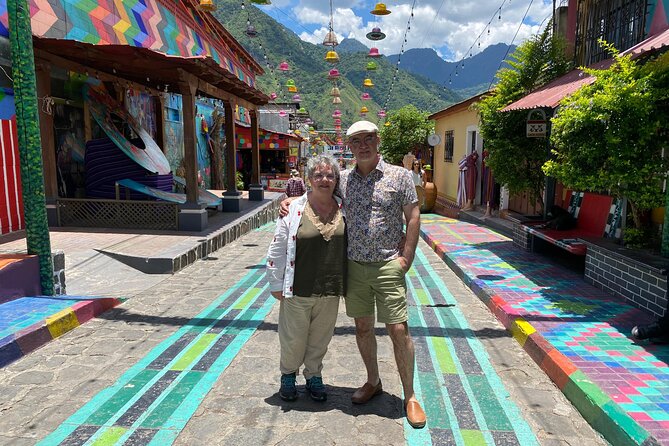
Reviewed · MAYAN CULTURE TOURS IN LAKE ATITLAN
Authentic tour of Mayan art and culture in Lake Atitlan
This tour is interesting because it maps Mayan art, daily craft work, and faith across three connected villages around Lake Atitlan, so you see culture as something lived, not just displayed. What I really like is the chance to watch women weaving with natural dyes and to understand the spiritual side of the region, including Maximón and the synced local blend of traditions. One possible drawback to keep in mind, it is a full 7-hour day with three stops, so you will be moving and sampling rather than lingering.
I also like the fact that it is built for real conversation. The guide I had, Chema, was patient with English and made explanations easy, even when my Spanish was basic. Plus, you are not stuck doing it on your own, the tour caps out at 16 people and bottled water is included.
If you hate churches or markets, you might find parts of the day more about observing than shopping. Still, even if you only care about art, the context is what makes the crafts meaningful.
Key things to know before you go
- Three villages, one cultural theme: San Juan, San Pedro, and Santiago Atitlan each show a different side of Tz’utujil life.
- Crafts you can understand: natural dyes, hand weaving, local painting, and textiles come with stories behind them.
- Food and farming details: stop for chocolate and honey, including the role of the Mayan bee.
- Faith side of the culture: church visits show how indigenous and Christian traditions mix in this region.
- Small-group pace: up to 16 travelers, with Chema guiding and explaining in English.
- Admission is free where listed: the stops on this route use free admission.
Mayan Art Across Three Lake Atitlan Towns, in One Focused Day
This is a guided, hands-on style day focused on Mayan art and culture. You will visit three different villages on the lake, and each one has its own cultural voice. The trick is that the tour does not treat art as souvenirs. It treats art as a language, used by weavers, painters, chocolatiers, and market makers to explain identity, nature, and spirituality.
You will also get a clear sense of the Tz’utujil presence around the water. The tour starts on the San Juan side, moves to the more youth and Spanish-learning scene of San Pedro, then finishes in Santiago Atitlan, known for its strong cultural identity and deeper spiritual connections.
The best part is pacing. Three stops in about 7 hours is enough time to see variety, but not so much time that you spend the entire day in transit. The day is “active,” not rushed in a panicked way, and it is easy to follow because your guide keeps connecting what you see to what it means.
More Mayan Culture Tours in Lake Atitlan
- Mayan Nose Sunrise Hiking
★ 4.5 · 62 reviews - Lake Atitlan Cultural Tour Exploring Mayan Villages
★ 5.0 · 34 reviews - Mayan Nose Sunrise Hiking + Chichicastenango Market Tour
★ 5.0 · 22 reviews
Starting Point and Pickup: How You’ll Meet the Guide and Get Moving
You meet at Biblioteca Comunitaria Rija’tzuul Na’ooj in San Juan La Laguna (the listing gives the map pin MPV7+V38). The tour begins at 9:00 am, and it returns you to the meeting point at the end.
Pickup is offered. The tour notes that they will specify where to meet to collect people, and you can also send an address if you want them to plan where you will start. That matters because Lake Atitlan can be a bit tricky to navigate when you are relying on public transport and local timing. A pickup removes that stress.
It is also described as near public transportation, and “most travelers can participate.” That is helpful language if you are deciding whether to join without committing to a super technical hike. You should still expect walking in village areas, especially when moving through markets and workshop spaces.
Group size is capped at 16 travelers, which is a sweet spot. It is small enough for questions and slower explanations, but big enough that you feel the energy of a shared experience without losing personal attention.
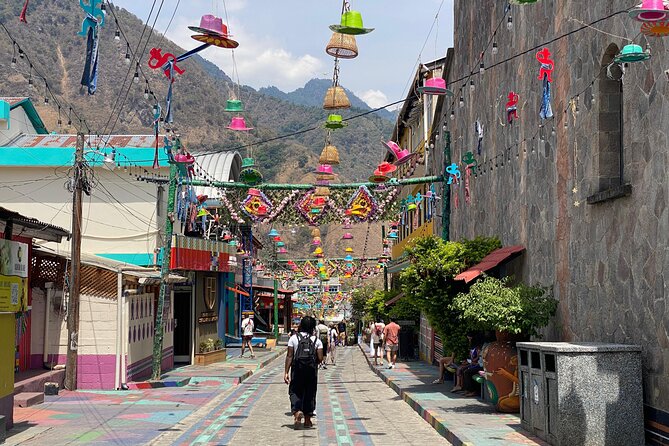
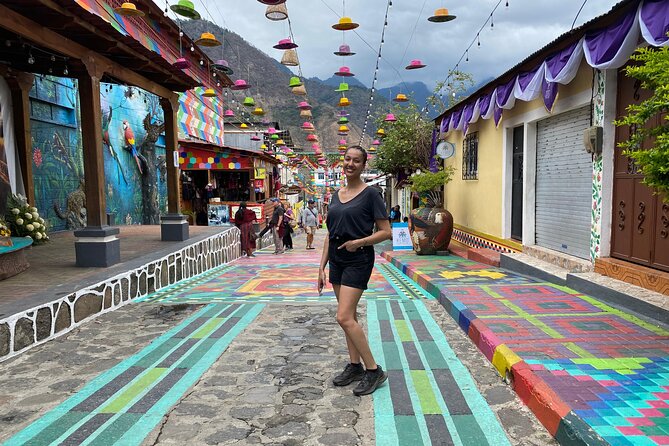
Stop 1: San Juan La Laguna Murals, Weaving Workshops, Chocolate, Honey, and St. John the Baptist
San Juan La Laguna is a Tz’utujil village on the shores of Lake Atitlan, known for a strong harmony between culture, nature, and spirituality. You are there for about 3 hours, which is the most time of any stop, and it makes sense because there is a lot to take in.
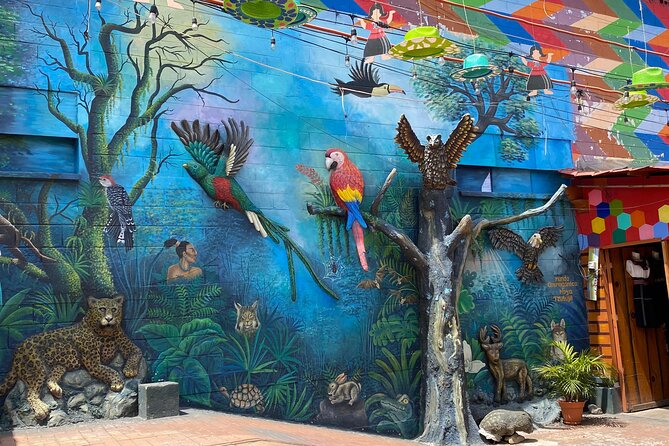
Murals that tell the Mayan worldview
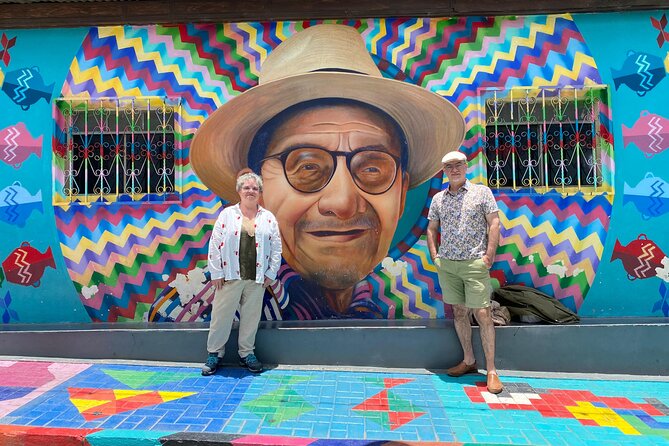
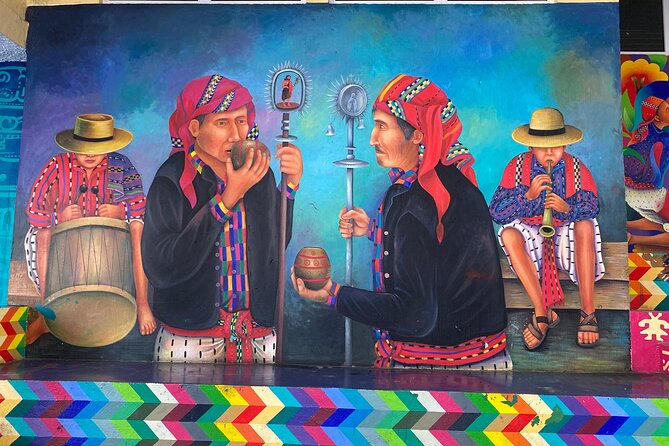
The first layer is visual storytelling. You will explore colorful murals that explain stories of the Mayan worldview. This is one of those moments where you can look and then instantly start asking better questions. The murals are not just decoration. They help set the tone for everything that follows, especially how the community connects nature, belief, and identity.
More Mayan heritage tours in San Pedro La Laguna:
- From San Ignacio: Tikal Maya Site Day-Trip with Local Lunch
★ 4.8 · 94 reviews - Tikal Private Day Tour Maya Adventure from Flores
★ 5.0 · 73 reviews - Iximche and Antigua Day Tour
★ 4.7 · 63 reviews - Iximché Ruins and Antigua City Tour from Guatemala City
★ 4.5 · 61 reviews
Women weavers using natural dyes
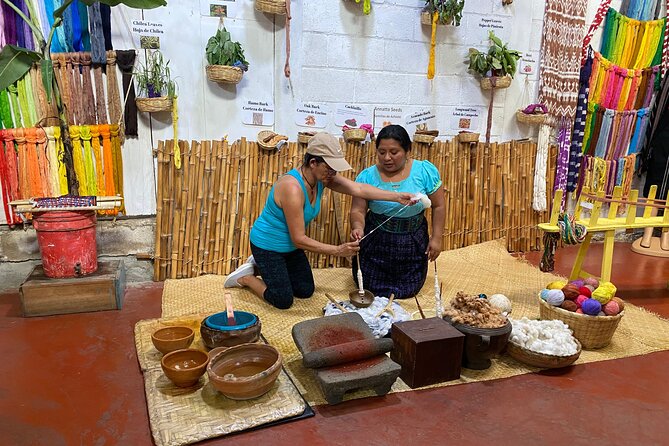
Next comes one of the best parts of the whole day: meeting women weavers’ cooperatives that use natural dyes from plants or tree bark. This is where “Mayan art” stops being an abstract phrase.
You will see textiles made with ancient techniques, and the natural dye detail matters because it connects the artwork directly to local materials and knowledge. Even if you do not buy anything, you come away with a better understanding of why these patterns and colors carry meaning beyond style.
If you want to shop later, this stop is also where you learn what to look for. You can spot the difference between mass-produced crafts and pieces tied to a specific process, like dyeing methods and weaving work.
Indigenous art workshops and local painters
After the weaving, you will visit indigenous art workshops where local painters represent their identity and their connection to nature. This broadens your idea of art beyond textiles. It also keeps the day from becoming repetitive. You see how painters tell stories visually too, using themes grounded in the same cultural worldview.
Artisan chocolate and honey, including the Mayan bee
Then the tour shifts into tasting and agriculture. You can visit small artisan chocolate workshops and pure honey producers. You will also learn about the role of the Mayan bee in local agriculture.
This is not just a food break. It is another example of how nature-based knowledge shapes culture. A honey producer is not only selling a product. They are pointing to a working relationship between people, insects, and crops.
Finish with syncretic faith at St. John the Baptist
The stop wraps with a visit to the Catholic Church of St. John the Baptist. The interesting part here is what the tour emphasizes: this is a place of faith where indigenous and Christian traditions mix. You will see cultural syncretism in practice, not as a theory.
Admissions at this stop are listed as free, and the time allocation gives you enough minutes to look, reflect, and ask questions without feeling like you are being herded through.
A small practical note
San Juan is where the most “workshop time” happens, so bring a bit of patience. The conversations can run slightly longer because your guide is explaining details and you are being shown how things work. That is part of the value, but it is also why the day feels full.
Stop 2: San Pedro La Laguna Spanish Learning, Market Snacks, and San Pedro Apostol
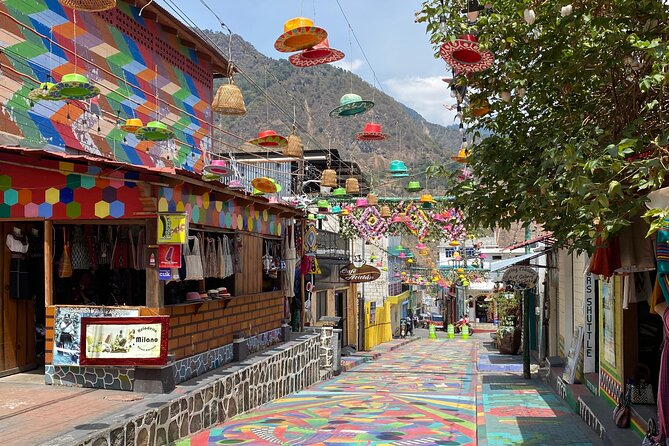
You then move to San Pedro La Laguna for about 2 hours. If San Juan feels more focused on craft and spiritual rhythm, San Pedro has a different energy. It sits at the foot of the imposing San Pedro volcano, and it combines Tz’utujil heritage with a more outward, visitor-friendly vibe.
Why San Pedro is a Spanish-learning hub
San Pedro is famous for being one of the best places to learn Spanish in Guatemala, mainly due to the many schools with local teachers and the quality of the teaching environment. That matters even if you do not take classes, because it shapes how the town works. Signs, conversations, and everyday life feel bilingual enough that you will likely hear Spanish everywhere and feel less lost.
Artisan cafes and local organic coffee production
You will also find artisan cafes, many tied to local organic coffee production. This is a good place to slow down for a moment. Even if you do not sit for a long coffee, you can use this time to take in the lake views and reset before the final stop.
The central market
In the center of the village, you can tour a colorful local market. Expect fruits, textiles, and traditional products. Markets are where you see how craft enters everyday buying and trading.
This is also where you can use what you learned in San Juan. When you look at textiles or dyed items here, you can ask yourself: does the piece reflect the same dye and technique story you heard earlier, or is it more generic?
Church of San Pedro Apostol
The stop includes the Church of San Pedro Apostol, described as a colonial gem surrounded by history and devotion. Like the church in San Juan, it is not only architecture. It is a window into how faith and community life sit side-by-side.
Admissions for this stop are listed as free, and you are given just enough time to walk around and soak in the atmosphere without it turning into a long church-only segment.
Drawback to consider
San Pedro is a good town for people-watching and browsing, but if your top priority is very specific art production (like dyeing and weaving), you may find this stop more mixed with cafes and market browsing. It is still worth it, because it changes the tone of the day and gives you context for why Spanish schools exist here.
Stop 3: Santiago Atitlan Maximón, Hand Embroidery, and the Church of Santiago Apostle
Your final stop is Santiago Atitlan, known as one of the most authentic and deepest villages in the Lake Atitlan area. You will spend about 2 hours here, and the themes are strong: hand-embroidered textiles and spiritual connection, especially around Maximón.
Hand-embroidered textiles as identity
Santiago Atitlan stands out for its impressive hand-embroidered textiles. This is a good place to pay attention to technique and detail. Compared with San Juan’s weaving cooperative focus, Santiago feels more centered on the kind of embroidery that can look like visual handwriting, small decisions repeated into a pattern you can read over time.
If you are shopping, this is often the stop where you might see the most “wow” craft work on the spot, because embroidery can be slower and more detailed.
Maximón: a living spiritual thread
The spiritual highlight is Maximón, a Catholic Mayan deity revered with offerings of tobacco and liquor. This is one of the most memorable parts of the day because it connects art to belief systems that are still active in community life.
You are not just hearing about a symbol. You are learning how it is practiced, which changes your understanding of what you saw in the murals and the church blending earlier. Maximón also makes the whole day feel coherent. The tour is essentially showing you how local belief shapes local creativity.
Historic Church of Santiago Apostle
You will visit the historic Church of Santiago Apostle, described as one of the oldest temples in the region. Like the churches earlier in the day, this is where you see faith and local tradition overlapping.
You can explore local markets and traditional craft workshops too, and you can walk through streets full of living history. It is an ending that feels less like leaving a checklist behind and more like closing the loop on what you started understanding.
Practical note
Santiago can feel intense in a good way, especially if you are sensitive to religious practices and offerings. Keep your tone respectful, ask before photographing, and let your guide lead the moment. This is one of those parts of travel where manners matter more than your camera.
What the Art Teaches You (Beyond Buying Textiles and Prints)
Here is the big value of this tour: it connects art to systems. You learn why the crafts exist, not just how they look.
Natural materials are knowledge
San Juan’s natural dyes from plants and tree bark are a perfect example. Instead of “pretty color,” you hear the reason color happens at all. That ties to local ecology and local know-how. It also explains why some pieces cost what they cost. Someone is not just making a product, they are preserving and practicing a process.
Faith shows up in daily life
The churches, plus the Maximón focus, show you religion here is not a clean separation between categories. Indigenous and Christian traditions blend, and you can see how that blend shapes community identity. Even if you are not religious, you can respect this as a living culture.
Markets are where art becomes part of life
Markets in San Pedro and Santiago show that art is not confined to workshop walls. It is used in trade, daily buying, and social identity. That makes you a better shopper too, because you learn what questions to ask and what details to notice.
Your guide makes it click
The best review highlight from this experience is the guide experience itself, Chema. He was helpful, kind, and attentive, and he explained everything patiently. He also worked hard to improve his English to communicate clearly. That effort matters, because art and spirituality are word-heavy topics. Without good explanation, the tour can become only visual. With Chema’s explanations, it stays understandable.
Price, Group Size, and What You Actually Get for $57
At $57 per person for about 7 hours, this tour sits in the “good value if you want context” category. The price is not trying to be ultra-budget, but it is not overpriced for a guided day across multiple villages with workshop access.
Here is what you get that justifies the cost:
- A guide for the whole route, with explanations in English
- A small group (maximum 16 travelers)
- Bottled water included
- Admission listed as free for the stops covered in the day
- A route that mixes workshops, markets, and church visits
What is not included:
- Lunch
That last bit matters. If you go in expecting lunch to be provided, you might feel hungry late in the day. Plan to buy something simple at a market or cafe when the moment fits you. The tour gives you enough village time that you can usually grab a snack without the day falling apart.
As for tickets, the itinerary indicates admission is free at the stops. That reduces the “surprise fees” feeling.
The overall value is strongest if you want something more meaningful than a self-guided stroll, especially if you do not speak much Spanish and you want someone to translate not only words, but cultural context.
Who This Tour Fits Best, and Who Might Want a Different Plan
This tour is a great match if you care about culture you can explain at home. You will likely enjoy it if you like:
- textiles and craft processes
- murals and local art that tells real stories
- learning about the spiritual side of Lake Atitlan communities
- a guide-driven day that keeps you oriented
It is also a good option if you want a day that feels structured but not rigid. Three stops works because you get variety without feeling like you are sprinting from place to place.
Who might hesitate:
- If you only want one type of art, like purely painting or only shopping, the day is mixed by design.
- If churches make you restless, you will still have church time in all three stops, plus a spiritually focused Maximón moment.
- If you hate any kind of walking through markets, you may want to choose a lighter option.
Should You Book This Mayan Art Tour of Lake Atitlan?
I think you should book if you want more than items to bring home. This tour helps you understand what you are seeing, from natural dye techniques to Maximón offerings, and it does it with a small group and a guide like Chema who gives patient explanations in English.
Book it if $57 feels like a fair price for a guided day with workshop access, market time, and free admissions at the stops. Pass if you are mainly interested in a beach-like relaxation day, or if you would rather spend the day only shopping without learning the meaning behind the craft.
If you want a “culture you can talk about” day in Lake Atitlan, this one is a strong choice.
FAQ
Where does the tour start?
The tour starts at Biblioteca Comunitaria Rija’tzuul Na’ooj in San Juan La Laguna (MPV7+V38).
Is pickup available?
Pickup is offered. The guide team will specify where they pick you up, or you can send an address for your start location.
What time does the tour begin and how long does it last?
It starts at 9:00 am and runs for about 7 hours.
How much does the tour cost?
The price is $57.00 per person.
Are admission tickets included?
Admission tickets are listed as free for the stops included in the day.
Is lunch included?
No. Lunch is not included.
What language is the tour offered in?
The tour is offered in English.
How big is the group?
The maximum group size is 16 travelers.
What is the cancellation refund policy?
You can cancel for a full refund if you cancel at least 24 hours before the experience’s start time. If you cancel less than 24 hours before, the amount paid is not refunded.
Just reviewed around San Pedro La Laguna
- Kayaking on Lake Atitlan★ 4.5 · 3 reviews
- Tour Hike to San Pedro Volcano★ 5.0 · 4 reviews
- indian´s nose / sunrise Trip★ 5.0 · 4 reviews
- Transporte Compartido de San Pedro- Antigua viceversa★ 4.5 · 6 reviews
- Tour in the Atitlan Nature Reserve★ 5.0 · 6 reviews
- Sunrise Tour in Indian Nose Hike and Views of Lake Atitlan★ 5.0 · 8 reviews
- One Day Hike – Atitlán Volcano★ 5.0 · 11 reviews
- Horseback Riding Tour in San Pedro La Laguna★ 5.0 · 14 reviews
Mayan Culture Tours in Lake Atitlan, compared.

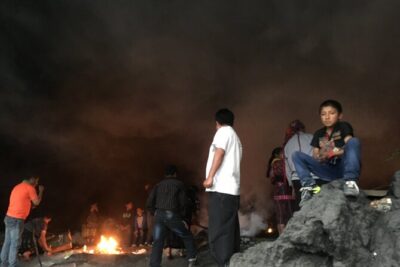
Lake Atitlan: Mayan Ceremony at the Sacred Caves
Read our review →Lake Atitlan: Mayan Ceremony at the Sacred Caves
Read our review →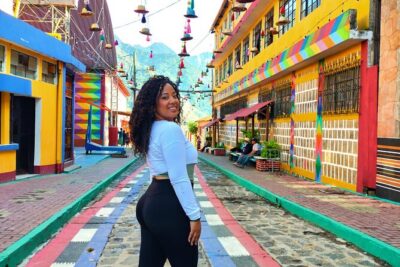
Lake Atitlan Cultural Tour Exploring Mayan Villages
Read our review →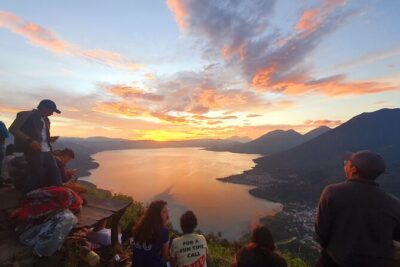
Mayan Nose Sunrise Hiking + Chichicastenango Market Tour
Read our review →
Lake Atitlan Lower Mayan Trail Hiking Tour from Panajachel
Read our review →Browse the lists this tour appears in